So you want to write a newsletter.
Smart. When they’re done right, newsletters are the highest-trust channel in your stack. No algorithm tax, no pay-to-play. Just consistent value delivered directly to the people who opted in for more of you.
At Morning Brew, we built a 4M-subscriber daily newsletter — and this playbook is the exact system we used to do it.
Download the PDF
Alex Lieberman grew Morning Brew to 4M subscribers. Here’s his step-by-step newsletter-building machine.
Get the playbook
Step 1: Pick Your Niche (aka audience) There are three newsletter audience types:
Personal passion (think: gardening, cars, luxury art, etc.) Prosumer (think: retail investing, alternative investing, etc.) Professional need (think: sales, software development, therapy, etc.) Is it a high-need audience? Proven things a newsletter can do:
Make you better at your job Increase your status in a community Make you/save you money Save you a bunch of time Entertain Next: Is it trending up?
Will the audience for this niche be bigger in 5 years? (Look at 1- and 3-year trends in Google Search Trends and reddstats,) Will the audience’s need/passion for the information be higher in 5 years? Is it a valuable audience? Is there a strong advertising model? Is it high CPM?
Rule of thumb:
Higher-earning audiences command higher CPMs Niche audiences command higher CPMs than general audiences Professional audiences (industry/job function-specific) command higher CPMs than consumer audiences Is there advertiser depth?
If you listed out every possible advertiser that would likely be interested to get in front of this audience, how long is that list?
<25: bad 25-50: average 50-100: good 100+: great There are two types of advertisers: endemic and non-endemic. Endemic is consistent with the content type, and non-endemic is inconsistent with the content type.
One framework I use to determine the value of the niche: The Content Pyramid.
Do they want/need a newsletter?
Is there enough content flow to command a (minimum) weekly newsletter? Would this newsletter be a natural extension of how the audience already consumes content? (Aka, is your audience email-native?)
Step 2: Build your Strategy Who is your market of 1?
Who is the one person you’re writing this newsletter for? Describe them in excruciating detail. If they’re a real person, even better. Pull their LinkedIn URL and write down everything you know about them.
If you're in the market of 1, ask yourself the questions below; if you’re not, ask 4-6 people in the market of 1.
Where do you get your favorite content about this niche? (Ideally, their answer isn’t a newsletter or a directly competitive newsletter.) What makes your favorite content so good? (Use them as general inspo for voice, content categories, length, etc.) If we could create the perfect newsletter for you, what would be in it? And what job would it do for you? What are questions/challenges/topics within your niche that you find keep you up at night or you talk constantly with peers about? (Use this as a starter list for topics to cover in the newsletter.) What is the goal of the newsletter?
You should be able to easily fill in these blanks:
What is the ideal frequency?
If news-based: minimum 2x/week. Ideally, daily, so you can build a habit. If evergreen: minimum weekly. Quite difficult to build a habit if it’s less frequent.What are the content sections (in your newsletter) that keep the reader engaged and satisfy the goal?
This should be informed by your market of 1.
You can mix and match existing content modules (below) based on what is best for your market of 1 and flows best from top to bottom.
Option 2 is to ideate content sections from scratch.
What is the voice?
Similar to market of 1, you should be as specific as possible about the voice of your newsletter.
There are 3 steps to nailing your newsletter’s voice:
Build a persona (think of the person that your market of 1 wants to be)
If it’s the mid-level marketer, then maybe the persona is the CMO. If it’s the weekend golfer, maybe it’s the golf obsessive who built an at-home swing simulator. Once you have your persona, write down every habit, quirk, and behavior you can about them.
Boil down to personality traits
List out the 3 most pronounced character traits of your persona.
Have examples of each personality trait
The best way to train your editorial team is to show them what is on- vs. off-voice voice for your persona.
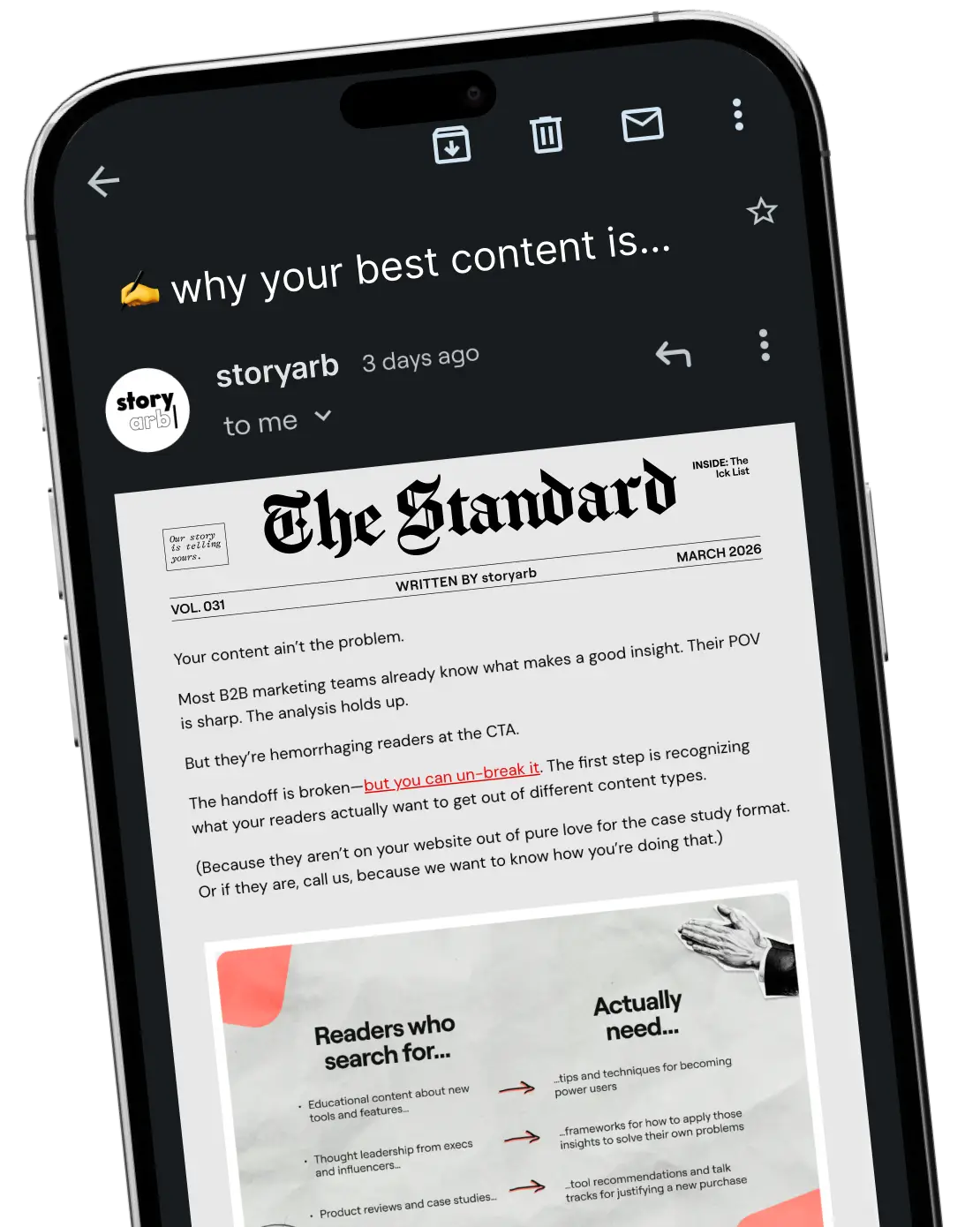
Subscribe to The Standard
Get more newsletter insights like this from our favorite newsletter: The Standard, written by storyarb.
Subscribe
Step 3: Pick the team There are three legs to the newsletter stool:
Content Growth Monetization There needs to be an owner for each leg of the stool (but the same person can own multiple legs). How you staff your newsletter depends on content needs (frequency, length), financial runway, and goals.
Here are a few options for staffing, based on the above variables:
Newsletter type
Who you need
Hobby
1 person owns editorial, growth, and monetization (if applicable)
Side hustle to business
Option A: 1 person owns editorial, growth, and monetization (if applicable)
Option B: 2 people - 1 owns editorial and 1 owns growth and monetization
Option C: 2 people - 1 acts as editor and oversees growth and monetization; 1 is a junior writer (intern, offshore, etc.)
Company content product
1 editor, 1 writer, 1 PM that liaises with growth/design/product
Direct monetization business
If daily: 2 writers, 1 editor, 1 growth/tech lead, 1 revenue lead (can be someone in demand gen)
If weekly/bi-weekly: 1 writer, 1 editor, 1 person who PMs and owns growth/tech/sales
Ad-based business
If daily: 2 writers, 1 editor, 1 growth/tech lead, 1 sales lead
If weekly/bi-weekly: 1 writer, 1 editor, 1 person who PMs and owns growth/tech/sales
At scale
2-4 on editorial, 2 on growth (one organic, one paid), 2-8 sellers, 1-2 design/tech support (or external agency)
Step 4: Create This 3-phase, 1-month process will ensure that you create a world-class newsletter that finds content-market fit within your niche.
Phase 1 - Nail the content (1 week)
Create an MVP of one newsletter in Google Docs (based on Step 2). It should be exactly what you’d plan to send to your audience, just without the final design. Create a trusted circle of 8-10 readers and critics. Don’t pick best friends or family. Pick people who are your market of 1, will give you helpful feedback, and don’t worry about hurting your feelings. Send your MVP to the circle, and have them answer the following questions: What is your favorite section of the newsletter? Why? What is your least favorite section of the newsletter? Why? How would you describe the voice/personality of the newsletter? Who (specifically) do you think would most benefit from reading this newsletter? What is one thing you’d change about the newsletter? What is one content idea you’d love to see tested in the newsletter? Edit the MVP based on the feedback that you believe enhances the quality of the newsletter. Once done, you now have your sample newsletter, which will act as your standard (format, voice, quality) moving forward. Phase 2 - Nail the process (1-3 weeks, depending on frequency)
The goal of phase 2 is to make sure your editorial standard is high and your editorial process (from content ideation to newsletter send) is operating like clockwork.
If your newsletter is daily: send 1 week (5 newsletters) of daily newsletters to your trusted circle.
If your newsletter is weekly: send 2-3 weeks (2-3 newsletters) of weekly newsletters to your trusted circle.
While you are nailing the process, you should be ironing out your newsletter launch checklist in the background:
Select your email platform (I <3 beehiiv ) Design your newsletter (Ricky Figueroa is great. He designed Big Desk Energy .) Design your website — at minimum, landing page, archive, and post-sign-up page (I’d use DesignJoy and then build within beehiiv.) Write your post-subscribe welcome email. Your goal with this email is to set expectations (what can the reader expect, when can they expect it, why should they be excited about it) and enhance deliverability (instruct them to reply to the email OR drag email to Primary.) Create a re-engagement flow that emails unengaged subscribers and gives them the option to stay subscribed (with a button click); if they don't, unsubscribe them. List hygiene is incredibly important for strong deliverability. Create your GTM plan (refer to step 5.) You should have at least 1 test run with your trusted circle that includes the full user flow (website → sign-up → post-signup page → post-subscribe welcome email → email in inbox).
Phase 3 — Nail the launch (1 day).
Great launch = A+ GTM execution + A+ execution of the first newsletter
Step 5: Grow A few golden principles for newsletter growth:
Content is your greatest growth lever. Content-market fit combined with a great growth plan can create exceptional outcomes. Without content-market fit, growth will always feel like a slog, and you’ll never have an exceptional outcome. Second to content, retention is a wildly underrated growth strategy. It is far easier to keep an existing subscriber (who is in your niche and already consumes newsletters) than try to convince someone new to join
the party. Newsletter growth is usually not like social growth. It’s slow and steady, and linear most of the time, with stepwise pops periodically. Quality of subscriber > quantity of subscribers. Whether you’re monetizing with ads, selling products to your audience, or literally just using your newsletter as a tool to build trust, it will always always always make sense to have a smaller, more engaged subscriber base. Option 1: Co-launch with a distributor
We grew Morning Brew from 0 to 1M subscribers in 4 years. The only way to speed up that timeline is a) by spending a sh*t ton on paid marketing day 1 (risky), b) going viral (highly unlikely), or c) partnering up with a company or creator that has significant, quality distribution in your niche.
Here’s how I’d approach a distributor conversation:
Have an ironclad plan for a newsletter (by completing all of the steps above) Create a list of distributors in your niche Get in touch with a few of the distributors Pitch the partnership Test the partnership (before securing) Option 2: Build your base brick-by-brick
To set your newsletter growth strategy, you should follow the marketing machine process I recently published.
To summarize it:
Step 1: Who is our ideal reader (read: your market of 1)?
Step 2: List out all of the hubs (marketing channels) that give us access to lots of spokes (your market of 1).
Step 3 : Calculate your marketing math. What are your 1-, 3-, and 6-month subscriber goals? How do you define a high-quality subscriber?
Step 4: What are the marketing channels you are going to prioritize, and how many high-quality subscribers do you think they will drive?
Step 5: How long will you be testing the channels before looking at performance and making adjustments/prioritizing top performers?
Step 6: What were the results from the marketing strategy thus far? Are we on/off track to hit our goals? What were the highest performing/lowest performing channels?
Step 7: Based on the results, what does the go-forward marketing plan look like?
Then, return to Step 5.
Step 6: Monetize Steps to start monetizing:
Understand your audience Establish your story Create your ad products Create your media kit Advertiser outreach Crush the pitch Close the deal Execute the partnership Reporting and retention These are just the highlights of my company newsletter creation plan. For the full approach, download the PDF here.